Transit · By the numbers
GoApex Route 1: twice the buses, twice the riders
On April 18, 2026, Apex's fare-free bus went from once an hour to every 30 minutes for most of the day and added Sunday service. Monthly boardings have since passed 2,000, more than double a year earlier, and the Town's cost per boarding stayed about the same.
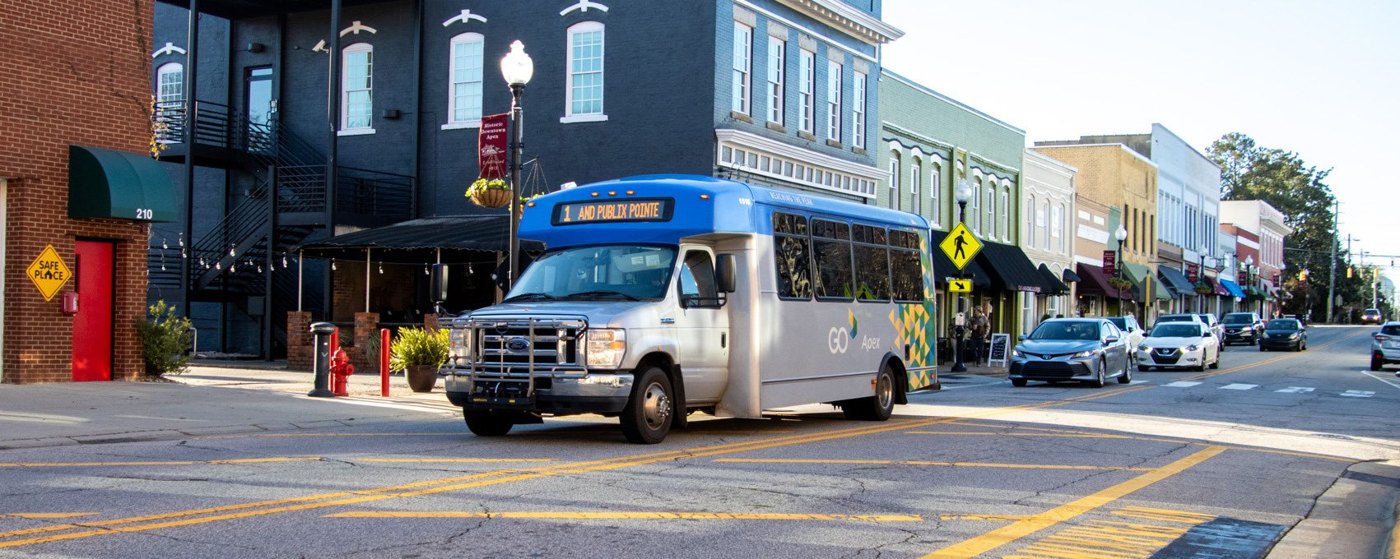
GoApex Route 1 is the Town of Apex's local bus. It is free to ride, runs a loop of about 14 miles, and is operated in partnership with GoCary, which also provides the companion door-to-door service for riders with disabilities. Trips start and end at the Town's Mason Street Municipal Building, a transfer point for GoCary Route 9 and GoTriangle's 305 to Raleigh, and the loop reaches downtown, Beaver Creek Commons and Publix Pointe.
What changed
From once an hour to every 30 minutes
The Town's 2023-24 annual report describes Route 1 running "once per hour, Monday through Saturday, from 6:00 am - 10:00 pm." Since April 18, 2026, the bus comes every 30 minutes from 6 a.m. to 7 p.m. Monday through Saturday, hourly from 7 to 10 p.m., and hourly on Sundays from 7 a.m. to 9 p.m. Switch between the two schedules.
Each cell is one hour, starting at the time shown (6 = 6 a.m., 21 = 9 p.m.). Service spans as published by the Town; exact departure times are in the Town's ride guide. Holidays differ (no service Thanksgiving or Christmas Day).
What happened
Riders showed up
Town staff report Route 1's numbers to the Multimodal Transportation Advisory Board. The Sept. 9, 2026 packet covers July 2025 through July 2026. Boardings ran about 1,100 a month in fall 2025, climbed in March and April, and have passed 2,000 every month since May. Tap a bar, or switch the measure.
"Per service day" divides each month's boardings by its days of service, so months with more operating days (Sundays were added in April) don't look busier than they are. July 2026 averaged about 73 boardings a service day; July 2025 about 39. All figures are staff estimates until the fiscal year's closeout.
The cost
Twice the service, about the same cost per ride
More buses cost more to run. But because ridership grew along with service, the Town's reported average cost per boarding barely moved from July to July.
The table reports operating cost per boarding; it does not separate out what the Town pays locally after outside funding. In FY2023-24, the Town's annual report says half of GoApex operating costs were paid with Wake Transit Community Funding Area revenue and half with local motor vehicle fees.
Reading the numbers
How a "boarding" is counted
Ridership is counted in boardings, also called unlinked passenger trips: each time someone gets on the bus counts once. A round trip is two boardings, and one regular rider can account for dozens in a month. The numbers measure how much the bus is used, not how many different people ride it.
The advisory board has asked about the count, too. At its May 13, 2026 meeting, one member said she was skeptical of the numbers and that the counting method had been changing, and Councilmember Arno Zegerman asked staff to take back an action item to clarify how riders are counted. The packet's tables carry the staff note that all figures are estimates until year-end closeout.
Ride it
Track it, ride it, tell the Town
Downtown, Route 1 is on a detour around the Salem Streetscape construction through December 2026, with temporary stops on Hunter, Salem, Hughes and Chatham streets. Real-time locations are in the GoCary app (Route 1 is listed as GA1). Mayor Pro Tem Terry Mahaffey also built a free live map just for Route 1, which an advisory board member referenced at a subcommittee meeting.
Bottom line
More service, more riders
When the bus came twice as often, people used it about twice as much, and each ride cost the Town about what it did before. The figures are estimates until the year closes and the count is still being clarified, but the direction is clear. Riders who want to shape what comes next can tell the Town in the GoApex rider survey.
Discussion
Comments