Downtown · History
Trees for Salem Street: 1966 to 2026
Apex's 1966 downtown plan found trees were rare and asked to bring them back to Salem Street. A 1976 plan asked again, the 1993–96 rebuild left them out, and the streetscape being built this year includes them.
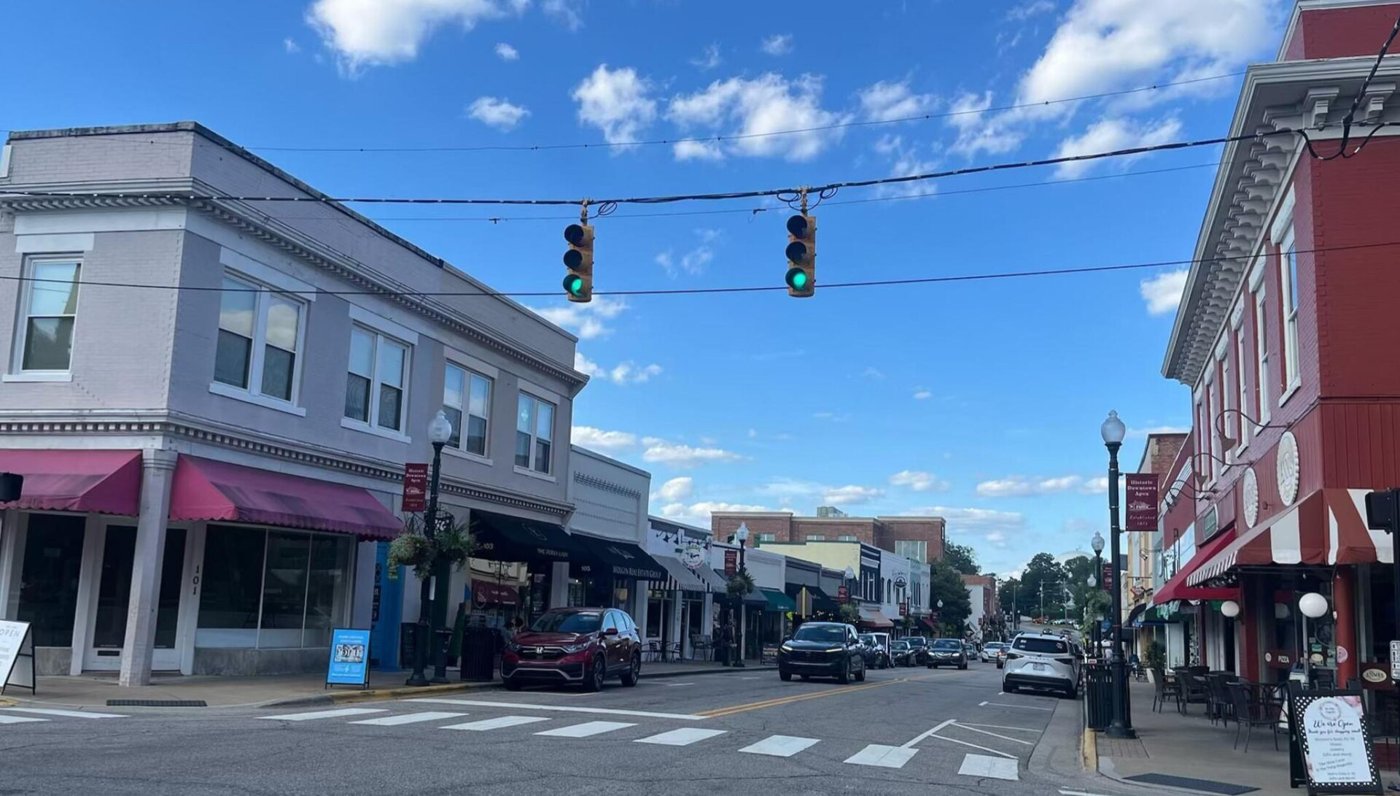
Downtown Apex has been planned and replanned for six decades. In September 1966, the Town's C.B.D. Improvement Plan, prepared with the N.C. Division of Community Planning, set out a staged program for Salem Street. Its first stage started with trees. Three decades later, the Town rebuilt the street, and the trees were left out again.
Apex's 2023 sesquicentennial history describes a downtown that had fallen on hard times by the late twentieth century, and presents the beautification work that followed as an effort to revive it. The 1990s project is often remembered as “1996,” but the Town's approved minutes show the steps stretched from late 1993 through 1996, with trees and parking still being discussed in 1997.
The stories below are drawn from those minutes, each shown as a scanned excerpt. They cover what was decided and what it cost where the record says, and they leave a gap where the record does not.
1966 to 1976
The first plan to bring the trees back
The 1966 plan was, in its own words, the result of a year-long effort by the Apex Planning Board, the Chamber of Commerce, the Downtown Improvement Association and other local groups. It found downtown short of parking and congested, and it noticed what was missing: trees had been uprooted years earlier to make room for progress and growth.
Its first stage called for a merchants’ Downtown Improvement Association, textured sidewalks, coordinated storefront colors with voluntary sign control, new street furniture, and trees spaced along Salem Street between Chatham and Center streets.
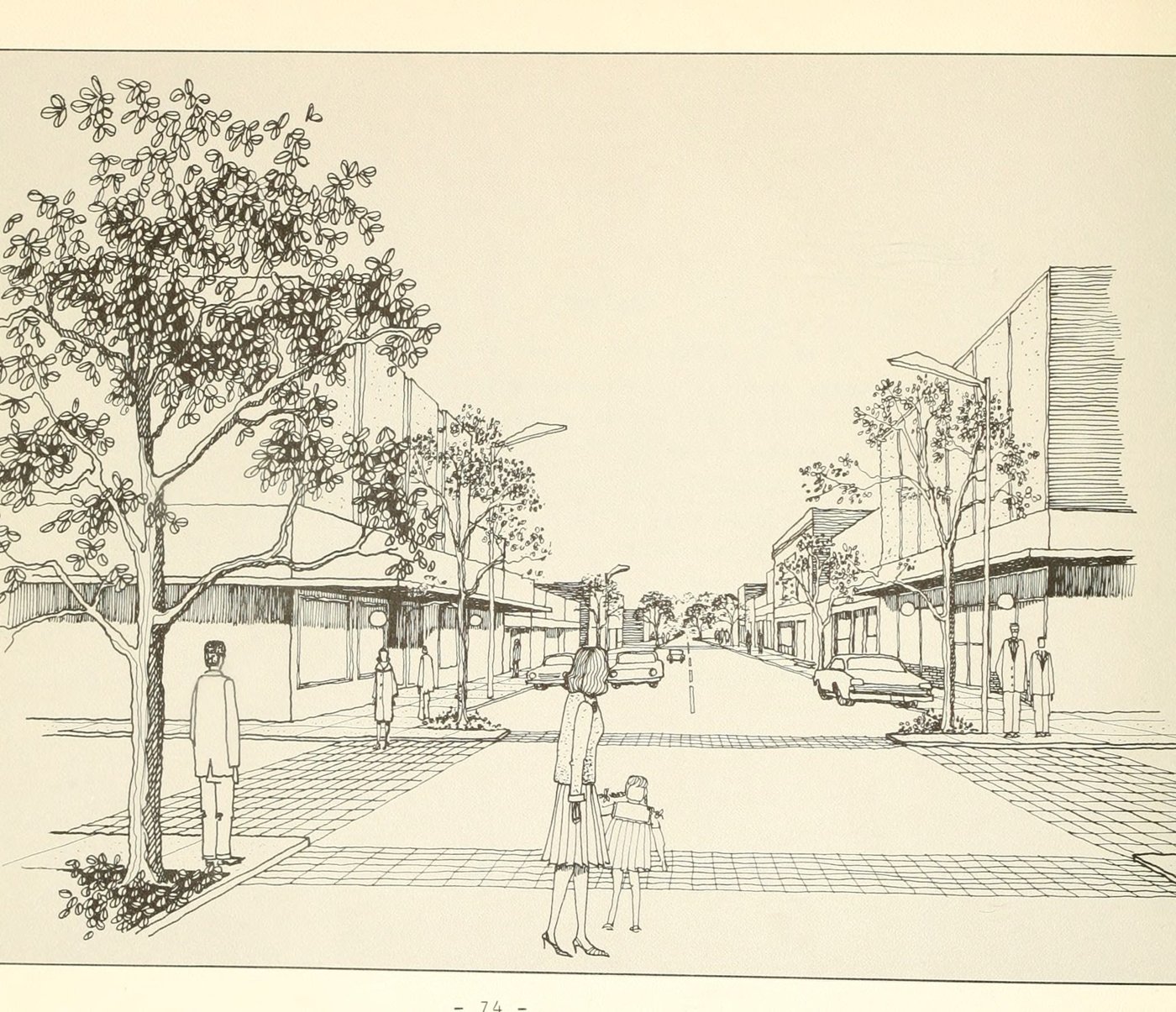
Much of that first stage happened. A 1969 community appearance study for Apex reported that unnecessary signs had come down, storefronts had been renovated with new color schemes, and a unified canopy plan covered much of downtown, including the Town Hall.
The trees waited. Apex’s 1976 Policies Plan noted that through traffic now went around downtown and saw an opportunity to plant seedling trees “for the future citizens of Apex.”
Walk the record
Eight moments from the minutes
Pick a date to see what the Board recorded. Tap an excerpt to enlarge it.
Dec. 21, 1993
A $2,250 study
The Board of Commissioners allocated $2,250 for a consultant to study the first phase of downtown streets and sidewalks. It is the first specific design authorization found in the minutes.
Jan. 18, 1994
Scheme 6, by 4–1
After the Planning Committee reviewed alternatives from the Sears Design Group, the Board approved “Scheme 6” by a 4–1 vote and authorized $2,500 for consultant construction drawings, also 4–1.
The Scheme 6 drawing is referenced in the minutes but was not recovered, so exactly what it contained is not documented here.
Apr. 19, 1994
$25,000 from the state
A state senator presented $25,000 in discretionary funds secured from the NC Senate for downtown street and sidewalk improvements.
May 2, 1995
A $110,000 paving bid
The bid for Salem Street resurfacing, curb and gutter came in at $110,000 from B&B Paving. The minutes say $82,000 was available and that NCDOT would make up the difference. Work could begin after May 8 and finish by August 31.
The $110,000 is a paving figure, not a project total. See “The money came in pieces” below.
Aug. 1 & Sept. 19, 1995
Street trees left out
In August, the Town Planner presented cost estimates for four street-tree alternatives and recommended Alternative B. The Board's consensus was that trees not be part of the project. In September, a motion to install drainage and tree pits for six to ten future trees, and to widen the brick paving, was denied 3–2.
The minutes record the votes but not each member's reasons.
Oct. 17, 1995
No through trucks on Salem Street
After a petition about oversized trucks and a staff review, the Board amended Town Code §20-118 to prohibit through trucks from the 900 block of North Salem south to East Williams Street (NC 55), effective November 1, 1995. It restricts through traffic; it is not a ban on deliveries.
May 21, 1996
A preservation award
The Board announced the Town had received an award from Capital Area Preservation for the streetscape improvements on Salem Street. The design firm's own award list identifies it as the 1996 Anthemion Award for Streetscape Improvements, Apex Central Business District.
Sept. 16, 1997
Merchants ask for potted trees
Downtown merchants brought the Board a proposal for 15 potted trees along Salem Street, Cherry Laurel and Yaupon Holly, based on the design firm's concept, and asked the Town to share the cost of buying and maintaining them. The Board referred it to the Planning Committee. The minutes do not show whether they were installed.
Try it
The money came in pieces
Check the boxes to add up the dollar figures in the minutes, and see why the record does not support a single total.
Pick one or more.
The minutes do not say whether the $25,000 is part of the $82,000, and the $110,000 covers paving, not necessarily sidewalks, lights, electrical work or design. Separate items, such as a $259,000 contract for a North Salem water-main extension, funded from unused water-bond money, may or may not overlap with the downtown work. The full authorized and final cost remains unresolved in the records reviewed.
Then and now
Street trees: 1995 and 2026
Asked for in 1966 and again in 1976, the trees came up once more in the 1990s rebuild.
- Aug. 1, 1995: the Board's consensus was that trees not be part of the project.
- Sept. 19, 1995: a motion to leave room for six to ten street trees failed, 3–2.
- 1997: merchants proposed 15 potted trees and asked the Town to share the cost; the Board referred it to the Planning Committee.
The Town describes the current design as including “urban street trees.” Underground soil cells, which give tree roots room beneath the pavement, are going in under the new sidewalks; on Nov. 6 the Town reported two of five soil cells complete on the west side and a third under way, with light poles and street trees scheduled to begin delivery in late October or early November.
Side by side
1993–96 and 2026
| 1993–96 | 2026 | |
|---|---|---|
| Design | Consultant study (Dec. 1993), then Scheme 6 adopted by a 4–1 vote (Jan. 1994) | Downtown Master Plan and Parking Study adopted in 2019; project design shared in a public meeting in Dec. 2022 (Town capital report) |
| What's built | Resurfacing, curb and gutter, sidewalks and brick paving; the Town's history also cites buried power lines and antique-style lights | Staggered parallel parking, widened paver sidewalks, urban street trees, decorative light poles, string lighting, planter boxes, wayfinding and street furniture, plus a Saunders Gathering Space (Town) |
| Street trees | Left out in 1995; potted trees requested in 1997 | Part of the design, over underground soil cells |
| Traffic | Through-truck restriction effective Nov. 1, 1995 | One side of the street closed at a time with an NC 55–Hunter Street detour; all businesses open (Town) |
| Schedule | Start announced for May 1994; paving window May–Aug. 1995; award May 1996. Actual start and finish dates were not recovered | Construction began Jan. 2026; substantial completion expected mid-Dec. 2026; final punch list mid-Jan. 2027 (Town) |
December 2025
When the bids came in high
Staff brought Council two options for the construction contract: award the low bid with a 10% contingency, or reject and rebid, possibly with a reduced scope, at the risk of missing the target of finishing before the next holiday season. Council chose to award.
Mayor Pro Tem Terry Mahaffey described the decision in his Dec. 17, 2025 newsletter. The low bid came in about $2 million over the engineer's estimate; the Town had rebid once and tried value engineering without finding obvious savings that would not greatly change the experience it wanted to deliver. Council weighed rejecting and rebidding, suspending the project, or pushing forward, and, he wrote, chose to push forward, unanimously.
His reasoning, in his words:
The same newsletter notes that the bid package required all stores to stay open and accessible throughout construction and capped the schedule at 270 days, to avoid affecting the fourth quarter of 2026, and that those protections added risk that drove up costs.
What it adds up to
Sixty years of asking for trees
The 1966 plan asked to “recall” the trees to downtown, and the 1976 plan asked again. The 1990s record shows a project built in steps, with money from several sources, a debate over trees that the Board settled one way in 1995 and merchants kept raising, and a preservation award at the end. The 2026 project keeps the trees in the design, builds the soil underneath them, and, according to the Town, is on track for substantial completion in mid-December. All of it is still under construction, and delivery dates can move: check the Town's project page for the latest.
Discussion
Comments