Town finances
Apex's finances, decoded
Strong Towns built a free tool that turns a town's audited financial report into seven indicators of fiscal health. Run Apex and six Wake County neighbors through it, and Apex comes out on top on five of the seven, one of them shared with Morrisville.
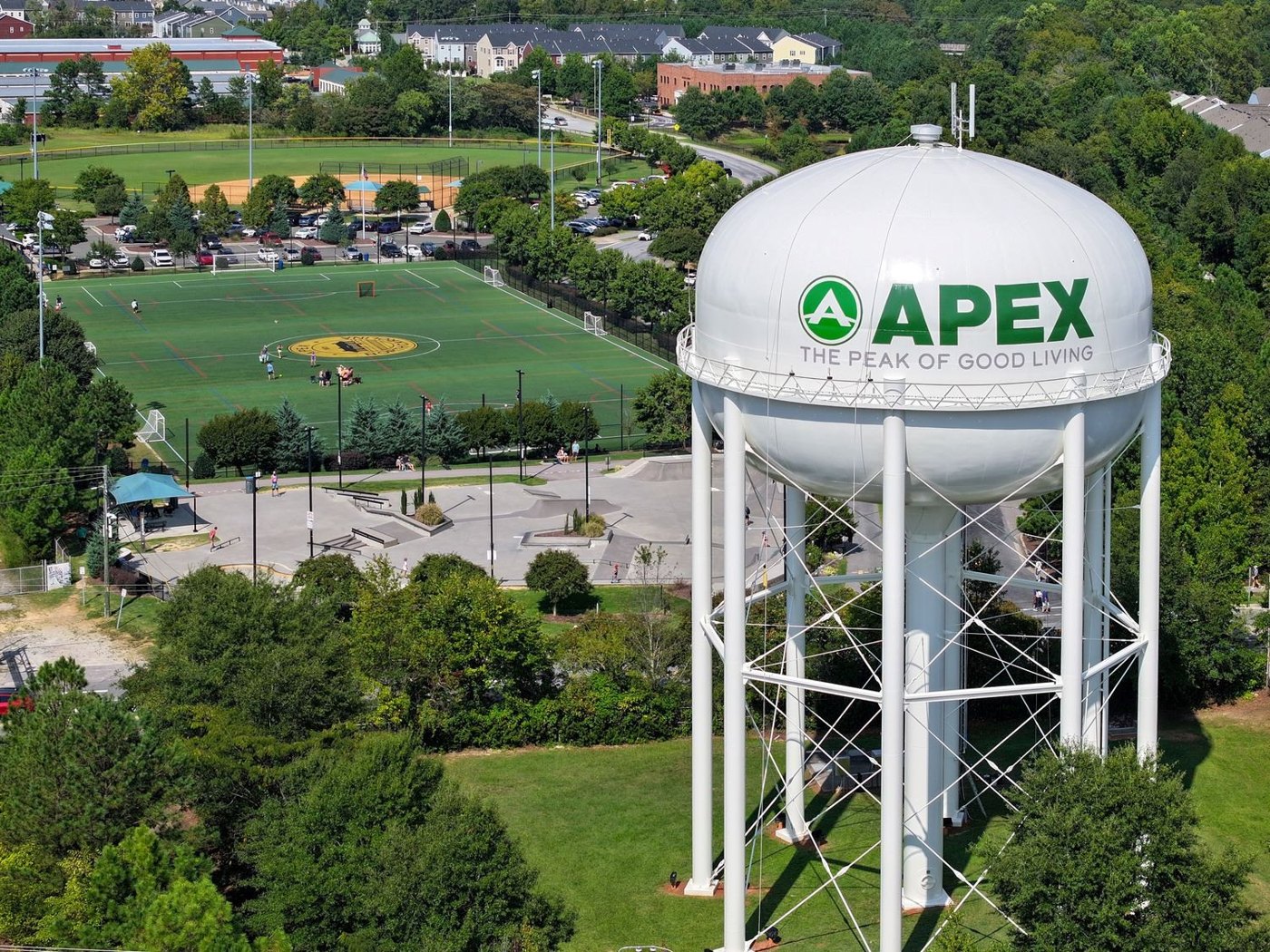
Every North Carolina town publishes an audited Annual Comprehensive Financial Report (ACFR) each year: hundreds of pages of tables few residents ever open. Strong Towns, a national nonprofit that writes about how cities pay for their growth, made a shortcut. Its Finance Decoder takes about a dozen numbers from those reports and turns them into seven indicators: can the town cover what it owes, how much room does it have, and how much does it lean on outside money.
Peak News Network ran the Decoder's own formulas on the fiscal year 2025 reports (year ended June 30, 2025) for Apex, Cary, Holly Springs, Fuquay-Varina, Wake Forest, Garner and Morrisville. Apex comes out on top on five indicators (on one, net debt, it ties with Morrisville at zero), including the two that matter most for resilience: it holds more in financial assets than it owes, and it spends the smallest share of its revenue on interest.
The tool
Seven indicators, three questions
The Decoder is a spreadsheet anyone can copy. It pulls its inputs from two parts of the ACFR: the summary tables in Management's Discussion and Analysis, and the capital assets note. It does not hand out grades; it shows where a town stands and which way it is moving.
Sustainability
Can the town cover what it owes?
- Net financial positioncash and other financial assets minus all liabilities
- Financial assets to liabilitiesthe same thing as a ratio; above 1 means a cushion
- Assets to liabilitieseverything owned, including infrastructure, per dollar owed
- Net debt to revenuehow many years of revenue any shortfall would take; zero if there is none
Flexibility
How much room does the budget have?
- Interest to revenuethe share of revenue spent on interest from past borrowing
- Net book value to costhow much useful life is left in roads, pipes and buildings
Vulnerability
How much depends on others?
- Grants and contributions to revenuemoney from outside the town's own taxes and fees
Compare
Apex and six neighbors, indicator by indicator
Pick an indicator. Each bar is one town's fiscal year 2025 audited report, run through the Decoder's formulas.
Net financial position is shown per resident so a town of 33,000 and a city of 191,000 can be compared fairly. One caution about any single year: when a town borrows for a big project, its cash and its debt both jump until the money is spent. Holly Springs and Fuquay-Varina both took on large borrowing in 2025, including for a water plant they are building with Sanford, which pulls their numbers down for now.
From Apex's audited report
Where Apex's numbers come from
Apex's inputs come straight from its fiscal year 2025 ACFR. Current and other assets of $282.3 million, minus $267.4 million in liabilities and deferred inflows, leaves the $15.0 million cushion. Interest on long-term debt was $2.9 million against $347.7 million in total revenues.
The trend
Apex over seven years
The Decoder is built to show direction. Apex's own reports from 2019 through 2025 show the cushion turning positive in 2024 and growing in 2025, while the interest share stays around one cent of every revenue dollar.
Context
The two indicators where Apex does not lead
A fair read of the Decoder includes the indicators where Apex is not on top, and what is behind them.
Grants and contributions: mostly donated infrastructure
Apex's grants-and-contributions share is the highest of the seven, at 36.5% of revenue. But most of it is not state or federal aid. In fiscal 2025, developers built and handed over $105.9 million in water lines, sewer lines and streets, which the audit counts as "capital contributions."
Teal: all other grants and contributions, $21.0 million. Without donated infrastructure, grants and contributions are about 6% of Apex's revenue. The other towns' reports also count developer contributions, in different amounts.
Net book value to cost: a large, established system
Apex's roads, pipes, electric lines and buildings carry about 71% of their original cost in remaining book value, the third-lowest of the seven (Cary 69%, Garner 53%). Apex runs its own water, sewer and electric utilities, and older assets are valued at what they cost when built.
The Decoder watches the direction: Apex was at 72.8% in 2019 and 70.9% in 2025, a slow drift while it added more than $1.2 billion in capital assets on the books. Keeping up with maintenance is what keeps that line steady.
Why it matters
Strong finances, out in the open
A cushion of financial assets and a light interest load are what let a town pay for growth without scrambling: it can build, borrow on good terms and absorb a bad year. The bond markets reach the same conclusion. Apex holds Moody's Aaa and S&P's AAA, the top ratings, and its auditors issued a clean opinion on the 2025 statements.
Mayor Pro Tem Terry Mahaffey has argued that Apex's record rests on responsible budgeting and small or no tax increases, and that the public should be able to see the numbers for themselves.
"Strong finances matter, and so does transparency about them."
Mayor Pro Tem Terry Mahaffey, May 29, 2026
Where things stand
Top of the group, and moving the right way
By the Decoder's own yardsticks, Apex ended fiscal 2025 with the strongest balance sheet of the seven towns compared here: a positive cushion, the most assets per dollar owed, no net debt and the lightest interest load. That cushion has grown two years in a row.
Anyone can check the math. Apex's reports are posted on the Town's Financial Reporting page, and the Decoder worksheet is free to copy.
Discussion
Comments